The PTAB Door Is Narrowing. Is Your Invalidity Expert Ready for Trial?
Fewer validity fights are ending at the Patent Office. More will end in front of a jury, and that changes which expert you should hire.
For more than a decade, the defense playbook went something like this: Get sued on a patent, file for inter partes review within the year, hire a technical expert to write a careful declaration and let the Patent Trial and Appeal Board decide whether the patent survives. The expert might sit for one deposition. Plenty never saw a courtroom.
That playbook is breaking down.
PTAB petitions fell 72% in the first nine months of 2026
Challengers filed 306 PTAB petitions in the first nine months of 2026, down from 1,086 in the same period of 2025. From the start of 2024 through the third quarter of 2025, the board took in between 328 and 366 petitions every quarter. Then the slide began: 194 in the last quarter of 2025, 130 in the first quarter of 2026, then 70.
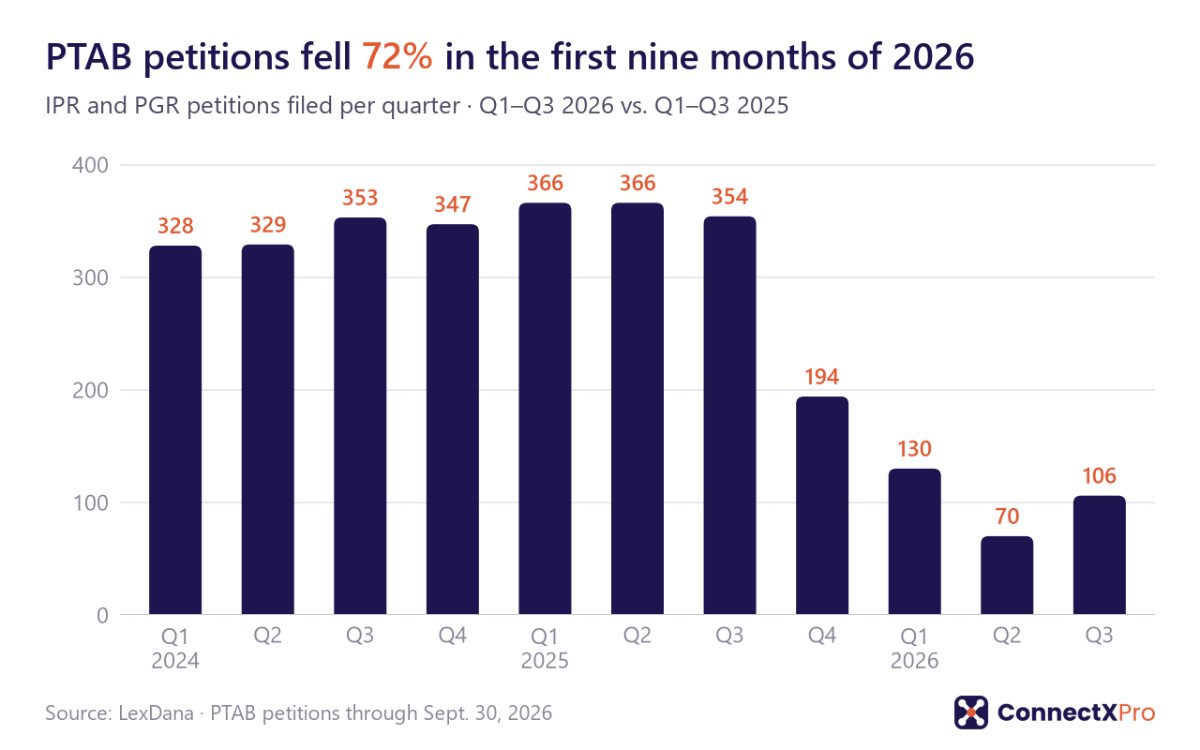
The third quarter brought a small rebound, to 106 petitions, still 70% below the same quarter of 2025. Through Oct. 26, our registry shows 335 petitions filed in 2026, on pace for about 400 for the year. In 2025 there were 1,280.
Try it yourself: Run this query in LexDana →
Why the door is closing
The Patent Act gives the USPTO director the decision whether to review a patent. For years, directors left that decision to the board’s judges. Since October 2025, Director John Squires has made it himself. The director weighs several factors in deciding whether to take a case: whether a court is likely to rule on validity first, whether the patent has already survived earlier challenges, how strong the petition is, how heavily it leans on expert testimony, and the board's own workload. One factor now weighs heavily: the patent owner's "settled expectations." The longer a patent has been in force, the stronger the case for leaving it alone, whatever the merits of the challenge.
Google tested that rule and lost. The board refused to review VirtaMove's U.S. Patent No. 7,519,814, in force since 2009, partly on settled-expectations grounds (IPR2025-00487 and IPR2025-00488). The Federal Circuit declined to step in on Jan. 27 (In re Google LLC, No. 2026-111), and on Oct. 19 the Supreme Court declined to hear Google's appeal (Google LLC v. VirtaMove Corp., No. 25-1230). Institution decisions can't be appealed, and the one remaining route, mandamus, has now failed at both levels. The policy stands.
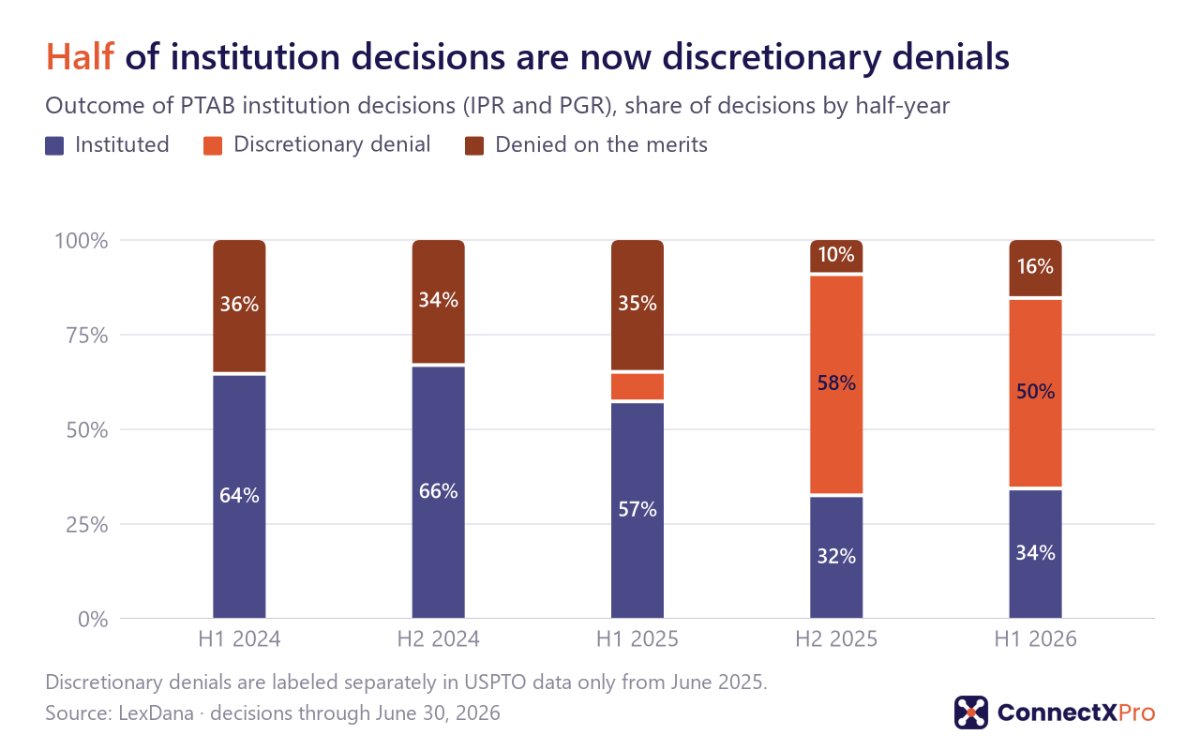
Google is far from alone. Since the USPTO began labeling discretionary denials separately in June 2025, the board has turned away 689 petitions that way through June 2026, without ever reaching the merits. In the first half of 2026, discretionary denials made up 197 of the 392 institution decisions, half the total. The board granted review in just 34% of decisions, down from 64% two years earlier.
Patent age now matters a great deal. In the first half of 2026, petitions against patents in force six years or more were instituted 26% of the time. For younger patents, the rate was 39%. Two years earlier, it was the other way around: petitions against older patents were instituted 68% of the time, against 61% for younger ones.
Since then, the institution rate has climbed back, to 63% of decisions from July through mid-October. That isn't the door reopening. Challengers have stopped bringing the cases they expect to lose. Only one in five recent decisions involved a patent six or more years old, down from about half in 2024.
The fight moved to court
Accused infringers still want these patents invalidated. Some are filing ex parte reexamination requests instead, 198 last quarter by LexDana's count. But a reexamination requester has no say once the request is filed: no hearing, no discovery and no appeal.
For everyone else, the validity fight goes back where it started: district court.
The VirtaMove patent shows how that plays out. In 2025 the board turned away nine petitions against it, from Google, Amazon, IBM and Oracle. On Oct. 13, a federal judge in San Jose found the asserted claims indefinite, and on Oct. 22 the court entered final judgment of invalidity for Google. VirtaMove can still appeal. But the question the board declined to hear got answered all the same: later, in district court, and under a higher burden of proof.
Why that's harder on your expert
Two things change when invalidity moves from the board to a jury.
The first is the burden of proof. At the PTAB, a challenger must show a patent is invalid by a preponderance of the evidence. In court, the patent is presumed valid, and the challenger must prove invalidity by clear and convincing evidence, the standard the Supreme Court affirmed in Microsoft v. i4i in 2011.
The second is the audience. IPR experts do get deposed, but the transcript goes to administrative patent judges with technical training. In district court, the expert defends the same opinion through a seven-hour deposition, a Daubert challenge to their methods and then live cross-examination in front of jurors who have never heard the phrase "claim construction."
Some excellent engineers are superb on paper and come apart under cross. Others can make a lay jury follow a video codec. When most invalidity fights ended at the board, that difference rarely mattered. Now it can decide the case.
Three questions to ask before you retain
- Has this expert testified live? Count trial appearances and depositions, not declarations. Ask how the last cross-examination went, then read the transcript.
- Has a court ever excluded or limited their testimony? Find the Daubert rulings and read what the judge actually said.
- Can they teach? Give them 15 minutes to explain the core technology as if you were a juror. You'll know quickly.
Start earlier than you think
District courts saw 4,445 patent filings in 2025, the most in at least five years. Those cases are now reaching claim construction and expert reports. PTAB petitions fell hardest in networking, telecommunications, and mechanical and medical devices, each down more than three-quarters from the first half of 2025. Biotech and pharma petitions fell less, by 55%. In the hardest-hit fields, demand for experts who can hold up at trial is likely to rise fastest.
Start the search when invalidity looks like your main defense, not when the expert report deadline shows up on the calendar.
Need a trial-ready invalidity expert? Tell ConnectXPro the technology and the stage of your case. We'll send a vetted shortlist of testifying experts, with their deposition and trial history up front, often within 24 to 72 hours. Request an expert
Methodology: LexDana figures cover IPR and PGR petitions and institution decisions through Oct. 26, 2026, and district court patent suits filed through 2025. Institution rates count each case's first decision to grant or deny review, excluding joined petitions. The split between discretionary and merits denials runs through June 30, 2026, because the USPTO labels discretionary denials separately only from June 2025 and recent denials have not been relabeled yet. Patent age is measured from grant date to petition filing. Technology areas follow the USPTO technology center of the challenged patent. Reexamination counts are from Unified Patents.
Sources: LexDana; VirtaMove Corp. v. Google LLC, No. 5:25-cv-00860 (N.D. Cal.): Claim Construction Order, Oct. 13, 2026 and Final Judgment, Oct. 22, 2026. This article is for general information and is not legal advice.
Need an expert for your matter?
Submit a case brief in 5 minutes. 2+ vetted candidates in 24–72 hours — no cost to search.
Request an Expert →More from Connect Insights
All articles →